
Your orders are shipped seamlessly between countries
You have the right to return your orders within 30 days.
Your payments are secure with our private security network.
Description
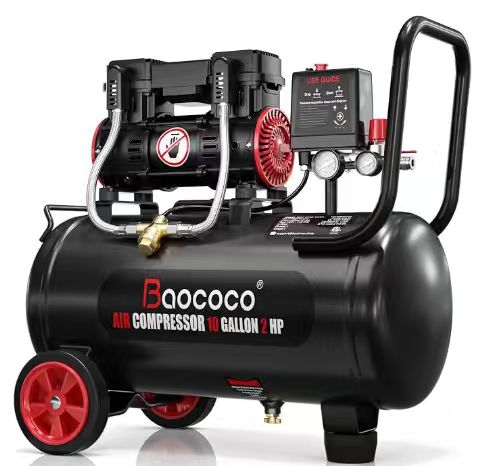
Best Budget 14-Gallon Ultra-Quiet Air Compressor
Introduction
If you need a versatile air compressor for garage projects, tire inflation, spray painting, or woodworking, this 14-gallon ultra-quiet air compressor is designed to provide a useful balance of power, capacity, and portability.
The compressor features a 2 HP oil-free motor, a 14-gallon tank, up to 115 PSI, and advertised airflow of 8.75 CFM at 115 PSI. It also uses a wheeled design with a handle, making it easier to move around a workshop or garage.
Another major selling point is its claimed 70 dB noise level, which is intended to make it more comfortable to use than many louder conventional compressors. The listing also describes dual silencers, cooling fans, and automatic overheating protection.
Pros & Cons
Pros
– Large 14-gallon air tank
– 2 HP oil-free motor
– Up to 115 PSI maximum pressure
– Advertised 8.75 CFM airflow
– Designed for relatively quiet operation
– Portable wheels and handle
– Two quick couplers
– Useful for tire inflation and workshop applications
– Automatic overheating protection
– Oil-free design requires less routine maintenance
Cons
– Larger than small portable compressors
– Corded operation limits where it can be used
– 70 dB is quieter than many compressors but not silent
– Heavy-duty tools may require checking their specific CFM requirements
– Actual performance can vary from advertised specifications
One important point when shopping for this type of compressor is to look beyond tank size. Air tools have different CFM requirements, so check the tool manufacturer’s recommended airflow before assuming the compressor can continuously operate a particular tool.
Comparison With Smaller Air Compressors
Small 1–6 gallon compressors are convenient for occasional tasks such as inflating tires or operating small nailers. However, their smaller tanks can require the motor to cycle more frequently.
A 14-gallon compressor provides a larger air reserve and can be more practical for garage and workshop applications. The advertised 2 HP motor and 8.75 CFM rating also give it considerably more capability than many basic household inflators.
That said, a larger tank also means more space and weight, so it makes the most sense for users who regularly work with compressed air rather than someone who only needs to inflate tires occasionally.
8 Useful Tips for Using It
1. Check your tool’s CFM requirement: Make sure your air tool’s requirements are compatible with the compressor.
2. Use the correct pressure: Adjust the output pressure according to the tool or application.
3. Keep the intake area clean: Dust and debris can affect airflow and compressor performance.
4. Allow adequate ventilation: Keep the compressor in a suitable area where heat can dissipate.
5. Inspect the air connections: Check couplers, hoses, and fittings for leaks before starting work.
6. Drain moisture regularly: Condensation can accumulate inside an air tank, so follow the manufacturer’s maintenance instructions.
7. Don’t exceed the rated pressure: Stay within the compressor’s specified maximum pressure.
8. Use proper electrical power: This model is listed as a 110V corded compressor, so verify your electrical supply and extension-cord requirements before use.
Conclusion
The 14-gallon ultra-quiet air compressor is an appealing option for users who want more capacity than a small portable compressor without moving to a much larger professional shop unit.
Its combination of a 14-gallon tank, 2 HP oil-free motor, 115 PSI maximum pressure, wheels, quick couplers, and advertised 70 dB operation makes it suitable for many garage and workshop tasks.
It’s particularly worth considering for tire inflation, nailers, air brushing, spray painting, and general workshop use, provided the required CFM matches the tool being used.
Overall, this compressor is best suited to DIY users and workshop owners who want a relatively quiet, portable air compressor with a larger tank and useful everyday versatility.

Reviews
There are no reviews yet.